
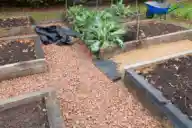
Manufacturers market landscape fabric (or weed barrier) as a long-term solution to reduce or prevent weed growth in your garden.
Who wouldn’t want that?
Unfortunately, for those of us who have installed landscape fabric before, we soon come to regret it. It doesn’t perform well long-term, and it usually ends up causing more problems than it solves.
Ultimately, it causes issues such as the following:
- Poor plant growth
- Hindering beneficial organisms in the soil
- Looking ugly if you don’t cover it with some sort of mulch
- Only reducing weed growth for about a year
Removing or replacing it is backbreaking, especially if it’s been buried for a few years under layers of mulch and soil.
In other words, we don’t recommend it.
However, landscape fabric does have some limited uses.
When And How To Use Landscape Fabric

Uses for landscape fabric include the following:
- Short-term installations, such as with annual plantings
- Putting it underneath pathways
- Putting it underneath permanent decorative features
In other words, landscape fabric is at its most effective and least frustrating when you plan to use it for a short time, ideally in a place you plan to have no plants.
Let’s dive deeper into each, starting with annual plantings.
Annual Plantings
In this case, we’re talking about planting something such as a vegetable garden for one season.
Landscape fabric made from woven plastics is better for this purpose than the polymer-spun ones that feel like felt. The latter are lighter weight, tear more easily, and don’t last well.
Various landscape fabric varieties – sometimes called “paper mulch” – are made from wood pulp. You use these for one growing season, then dig them into the soil to break down or dispose of them through local composting programs.
Also, because landscape fabric is black, it absorbs and traps heat from the sun, warming up the soil underneath it. This means the soil warms up sooner in the spring, giving you a head start on the growing season. Using landscape fabric for young transplants rather than direct seeding in the soil is best.
Steps
To use landscape fabric for growing annuals like vegetables, prepare your soil with any necessary amendments, such as compost.
You can use the fabric just to cover the planted rows and have grass or wood chips pathways in between, or cover the whole area (planting rows and pathways) with the fabric.
If using it to cover the whole area, overlap the edges by several inches so there are no bare patches of soil or cracks where weeds could grow. You can anchor the fabric with stones or bricks every few feet, pieces of 2×4 wood, or anything heavy. You can also use landscape staples (AKA garden staples).
If covering the whole area, decide where your planted rows and pathways will be. Mark the planting rows and walk only on the pathways so you don’t pack down the soil under the fabric where the plants will grow.
To plant young transplants, cut an X in the fabric, pull back the four corners, dig a hole, and plant as usual. Water the transplant and fold the fabric corners back around its base.
Drip irrigation or a soaker hose laid down under the fabric is the most efficient way to water when using landscape fabric. This minimizes moisture loss through evaporation before the water can soak through the fabric and into the soil.
You can carefully roll the fabric off the beds at the end of the growing season to use it again next year. Removing fabric this way prevents the soil from getting too packed and exposes it to the air, keeping the soil healthy.
Pathways
Operators of commercial greenhouses and plant nurseries use woven plastic landscape fabric as flooring. This is because it’s durable and can be swept clean.
You can do something similar with pathways.
Using landscape fabric underneath pathways like this (such as between raised garden beds) prevents you from having to mow grass.
Your best time to install it is when you’re constructing the raised beds with the garden bed edges overlapping the fabric edges by a few inches. This removes any gaps for weeds to grow.
Keep in mind you shouldn’t cover your landscape fabric. You may not like the look of it being exposed like this, but it’s the most efficient way to use it.
In short, leave the fabric bare and sweep it clean occasionally, or don’t use it at all. If not using it, use a thick layer (about six inches) of wood chips for your pathways instead.
Decorative Landscape Features
You can also use landscape fabric where no plants are or will ever grow. This includes areas for dry riverbed features covered with river rocks and stones. The fabric prevents the stones from sinking into the soil over time.
Be aware, however, that dust and soil particles will collect amongst the stones on top of the fabric over time. Eventually, this creates the perfect growing medium for weed seeds blown in on the wind. These weeds can root into the fabric and be hard to pull. Landscape fabric won’t eliminate the need to pull weeds in the long term.
When To Replace Landscape Fabric
Landscape fabric used as pathways not covered with mulch will be exposed to sunlight, which can break down the plastic fabric after several years. To extend the life of your pathways, use the thicker fabric made of woven plastic labeled as having UV protection.
Landscape fabric used for annual plantings should be carefully rolled up at the end of the growing season so you can use it again the following year. You’ll need to replace the fabric eventually when it starts to tear or gets holes in it (other than the planting holes) so that weed seeds in the soil won’t grow through.
If you choose to use landscape fabric covered with mulch in your garden beds (which we don’t recommend), it will be virtually impossible to replace because the mulch builds up over time, burying the fabric. Also, plants sometimes root into the mulch and fabric. Removing the mulch to get at the fabric is so much work, and plant roots may anchor it. You’ll soon find replacing fabric really isn’t an option.
It’s A Specialized Material
Landscape fabric (also known as weed cloth, weed barrier, and weed fabric) is a black woven plastic or felt-like material sold in rolls. Manufacturers often treat it with chemicals so it doesn’t break down in the sunlight over time. In other words, they make it to last.
They also sometimes treat the material with weed killer.
They make some newer fabrics from biodegradable materials like coconut fibers, grasses, or wood pulp. The claim is they break down once tilled into the soil at the end of the growing season. These are sometimes labeled as “paper mulch” and are marketed for short-term use.
The fabric being black blocks sunlight from reaching the soil, preventing weeds from growing underneath it. Landscape fabric also has fine pores to let water flow through it.
Unfortunately, the fabric isn’t very attractive, so most users cover it up with a nicer-looking mulch like shredded bark or wood chips.
Landscape Fabric Causes More Problems Than It Solves For Your Garden
At first, landscape fabric will prevent weed seeds from growing underneath it, and the fresh mulch will look nice and tidy. However, after a year or two, this will change.
Weeds Will Eventually Grow Anyway
The mulch will start to break down, collecting soil particles. This creates the perfect growing conditions for weed seeds carried by the wind. These weeds can root into or right through the fabric (like dandelions), which makes it harder to pull them out than if they were growing just in bare soil.
I’ve had garden clients who put down landscape fabric before I came to work on their gardens, and I’ve had to deal with plenty of weeds growing in the mulch over fabric. Believe me, the fabric creates more work in the long run than it’s worth.
There are also some weedy invasive plants (e.g., bindweed, horsetail, Japanese knotweed) that spread aggressively with underground runners called rhizomes. These can grow without light under landscape fabric and form thick spaghetti-like masses. They keep spreading until they find the smallest holes or come to the edges of the fabric, where they send up new shoots.
Topping Up The Mulch Buries The Fabric
Additionally, you’ll need to top these mulches every few years. This buries the fabric under ever more layers. I’ve worked with garden clients who’ve lived in their homes for just a few years and had no idea there was even landscape fabric in their garden beds!
Digging Holes Is A Nightmare
When I tried to dig holes for new plants, I couldn’t get my shovel into the soil because I hit a layer of landscape fabric. Since they’re designed to last, you can’t easily cut through these fabrics with a shovel. This is before considering how plant roots grow into the fabric.
Removing It Is Also A Nightmare
I always advise removing landscape fabric from garden beds, but that can be back-breaking work. Worth it for the health of the garden but not fun.
It Creates Poor Growing Conditions
After a year or two, landscape fabric doesn’t allow water to pass through it into the soil because its pores clog with fine dust and soil particles. As a result, the soil underneath starts drying out, and plants can’t get the water they need (keeping in mind how much water plants need per day varies).
The clogging also prevents oxygen and other gases from moving as freely through the soil’s surface and layers underground. This suffocates the soil and living organisms and roots in it. Eventually, the organisms may move somewhere else, making the soil even more unhealthy.
It Hinders Beneficial Organisms In The Soil
As an example, worms tunnel in the soil and keep it from getting packed down. They also move nutrients down into the soil for plants to use. Packed soil devoid of nutrients is unhealthy soil. When the soil is unhealthy, plant health will suffer, too.
Landscape fabric prevents this.
Extending Your Growing Season By Warming The Soil
Landscape fabric is black. It absorbs and traps heat from the sun and warms up the soil underneath it. This can be useful in the springtime to warm up the soil more quickly and get a headstart on the growing season for annuals and vegetables.
Landscape Fabric Inhibits Adding Soil Amendments
Once landscape fabric covers a garden bed, it is impossible to amend the soil to add organic matter. This is important to maintain soil health, replenish nutrients for plant growth, and ensure the soil doesn’t get compacted.
Removal Can Injure Plants
Plants surrounded by landscape fabric for several years will often grow roots into the fabric or the organic mulch laid over it. When you remove fabric from these plantings, it will often tear out plant roots with it. Depending on how much of the root system is torn out, this can cause severe stress to your plants.