

In this expanded guide: Why Do Hedgehogs Curl Up In a Ball? · When Do Garden Hedgehogs Give Birth? · Wild hedgehog houses and dry bedding · Can Hedgehogs Swim?.
Publisher’s update, 27 October 2026: Source-cited corrections were prepared with Codex. Specialist human review is pending; the original contributor’s byline is retained.
Leave wild hedgehogs free to move
Observe from a distance, keep routes between gardens open and check before mowing or moving garden piles. Do not assume a product is wildlife-safe because it is described as natural; the former neem-oil recommendation has been removed. If a hedgehog appears injured or unwell, contact a hedgehog rescue for advice before intervening.
Sources checked 27 October 2026: British Hedgehog Preservation Society: helping hedgehogs.
If you have a hedgehog in your garden, there are a few things to consider when it comes to its care and feeding.
Maybe it has been abandoned and needs care and attention, but maybe it’s just looking for a few bites to eat and somewhere safe to sleep.
I Have a Hedgehog in My Garden, What Do I Do?
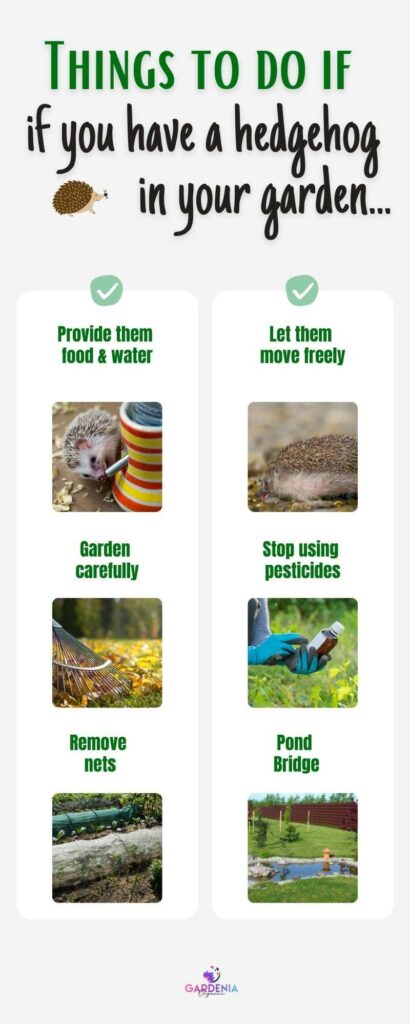
Provide Them with Food and Water
If you’re wondering, ‘I have a hedgehog in my garden, what do I do?’ then, first off, you can provide them with some food and water!
Hedgehogs eat mainly insects and will appreciate wet cat or dog food. Keep in mind that the smell might attract other night critters, however.
Many find that it’s best to feed their hedgehog visitors in some sort of shelter. One that only a hedgehog can fit into should do the trick!
Make Sure Hedgehog Visitors Can Get Out of Your Yard
You may be tempted to seal off your yard, to encourage your hedgehog visitor to stay.
As hedgehogs are wild animals, this is sure to stress them out.
In Fact: Hedgehogs are accustomed to traveling as far as a kilometer a night. This is an active and free-spirited critter!
Garden Carefully
Hedgehogs like to burrow into leaves, dirt, and other loose material.
This means that, if you’ve got a hedgehog in your yard, you’ll need to garden carefully.
Otherwise, you might accidentally bump or nick the little fellow with a garden tool!
Don’t Use Pesticides as These Can Be Harmful
If you’ve noticed a hedgehog in your garden, we strongly recommend that you stop using pesticides.
If they consume something with pesticide on it or even absorb it through their skin, hedgehogs (and all manner of animals) can get very sick!
Remove Any Nets in Your Garden
If you use nets in your garden, and a hedgehog shows up, you may want to put the nets away.
Hedgehogs are a bit bumbling and clumsy, and with all those spines, they can easily get tangled up or stuck.
Instead, you may want to opt to protect your garden from pets and critters with tomato cages, fences, or another kind of cover!
Provide a Bridge or Beach for Your Pond
If you have a pond, you may want to provide a bridge or beach for your hedgehog visitor.
Hedgehogs are good swimmers, but it’s possible that if they climb or fall in, they might not be able to get out.
This can even present an unlikely but potential drowning risk.
Instead, make sure they’ve got dry land that can be reached easily, and a bridge to help them if they feel the need to cross the water!
Hedgehogs are Nocturnal
Did you know that hedgehogs are nocturnal?
This is why they are so seldom seen, no doubt. A glimpse of this adorable, unique-looking creature can be a real treat.
If you see a hedgehog snuffling around at night, they’re probably just exploring or looking for a snack.
There may be cause for concern if you see a hedgehog out during the day, however! Sometimes, this means that they are injured or sick.
Have You Noticed? Keep an eye out for any signs that the hedgehog may be unwell, such as lethargy, flies buzzing around them, and a disheveled look. These guys may need to be rescued and taken to a rehabilitator!
Why Do Hedgehogs Curl Up In a Ball?
Why Do Hedgehogs Curl Up in a Ball?
A hedgehog will curl up into a ball to protect themselves and/or get some privacy. This is quite similar to when a turtle goes into its shell.
Go Easy: Hedgehogs are very timid creatures, and they tend to curl up super-fast at the slightest perceived risk!
Why Do Hedgehogs Sleep In a Ball?
Hedgehogs sleep in many positions, such as on their belly or half-curled up.
The most common one is fully curled into a ball, however. They do this because they feeling a lot safer and letting their guard down with spines to guard their back!
When Do Garden Hedgehogs Give Birth?
The Timeline of Hedgehog Breeding
- January to February: At this point, most hedgehogs will be in hibernation. They are mostly inactive unless they are disturbed or if the weather turns unusually mild.
- March: Hedgehogs start to come out of hibernation. They can lose roughly one-third of their body weight while hibernating, so their main goal at this point is to eat as much as possible.
- April: Hedgehogs at this point normally do two things. First, they are trying to build up the body fat they lost over the winter. Second, they start looking around for good nesting sites.
- May: The mating season begins. Males circle the females until one agrees to mate, then they leave and have no part in the rearing of their young.
- July: When the hoglets are three to four weeks old, they join their mother on foraging trips. They learn what to eat and what not to eat but also return to the nest for mother’s milk.
- September: Some females give birth a second time in September or October. However, these babies aren’t as likely to survive the winter as the ones born in June.
- October: Hedgehogs once again start to eat a lot and build their nests in order to get ready for hibernation.
- November to December: Most hedgehogs start the hibernation process in November, which for most of them will last until March.
If there is an unusually mild winter, the hoglet season could begin in early spring and continue until the fall.
Less-known Facts: Many times the mother will desert or even eat the hoglets, especially if she is somehow disturbed. Mothers have even been known to carry a hoglet in her mouth to a new location and leave it there.
Wild hedgehog houses and dry bedding
A dry shelter for a wild hedgehog
Site a hedgehog house in a quiet, sheltered, shaded part of the garden with a dry interior and an unobstructed entrance. Leave dry leaves nearby so a visiting hedgehog can gather bedding. Do not capture a wild hedgehog to occupy it, confine it in a cage or add litter-training material.
Avoid opening or moving an occupied house, particularly during breeding or hibernation. Only clean when you are sure it is empty; follow the British Hedgehog Preservation Society’s hot-water-and-brush guidance and let the shelter dry. Keep food separate from the sleeping compartment and maintain garden access.
Sources checked 27 October 2026: British Hedgehog Preservation Society: hedgehog homes.
Hedgehogs are small-to-medium-sized mammals native to Europe, Asia, and Africa.
Can Hedgehogs Swim?
Can Hedgehogs Drown In Water?
Just because hedgehogs are naturally good at swimming doesn’t mean they can never drown. In fact, drowning is still a very real possibility for hedgehogs that spend too much time in the water or fall into deep bodies of liquid while playing around near them.
If you have a pool or other body of water on your property, it’s important to take measures to prevent your hedgehog/s from drowning.
This means that if a hedgehog falls into deep water and becomes exhausted from trying unsuccessfully to climb out, he could eventually drown as a result of fatigue.
Final Words
So, if you’ve been wondering, ‘I have a hedgehog in my garden, what do I do?’ there’s your answer.
You can either ignore them or provide the little fellow with some food and water.