

Publisher’s update, 27 October 2026: Source-cited corrections were prepared with Codex. Specialist human review is pending; the original contributor’s byline is retained.
Compare heat retention before choosing a heater
Insulation and draught reduction retain heat; they do not generate it. Passive solar gain depends on sun, glazing and season and cannot promise frost protection overnight. A solar-electric heater also needs a correctly sized power and storage system; small panels are not equivalent to a mains heating circuit.
Do not build heaters from cans, barrels or old fuel cylinders, burn a fire beneath improvised water pipes, or use an outdoor combustion appliance inside a shed. Fuel-burning heaters can produce fatal carbon monoxide. Any fixed combustion installation needs an appropriately qualified installer to assess the appliance, flue, combustion air, clearances and local requirements. A carbon-monoxide alarm does not make an unsuitable installation safe.
For occasional daytime gardening work, compare insulation and sunlight with the cost of a professionally designed heating system. If reliable frost protection is essential, get a heat-loss and power assessment instead of relying on a DIY flame or solar promise.
Sources checked 27 October 2026: CPSC: heaters, furnaces and fireplaces.
Many people have a garden shed out in the yard, and it is useful in a lot of different ways.
You get extra storage for hobbies, gardening supplies, and more.
Farmers use them for farm equipment or feed and hay, and some people consider converting them to a tool shed or a greenhouse.
Add Insulation
Garden sheds are usually just a frame without much insulation.
They aren’t designed as a living space, and they store items that don’t need climate control.
They are used to protect tools and equipment from the weather, but most of the items can handle cold temperatures.
In the winter, it can be very cold inside the garden shed. If you plan to spend any time there, you will want to warm it up.
Unfortunately, people often don’t have any electricity running to the shed, so they need to find another way to make it more tolerable.
Most sheds aren’t insulated, so you can add insulation. This will make the shed more useful because you will be able to spend time in it comfortably in the winter.
Even if you plan to use another method to heat it up later, you will want insulation to make sure that the heat stays in.
Make sure that you run insulation around the walls and the ceiling. If it has an open stud construction, it is easy to do, and you will notice a difference right away.
Always Good Idea: This is a good first step toward making your garden shed warmer because you will need insulation if you plan to add another form of heat later on.
Add a Window
The sun can add a lot of warmth to any space, and a garden shed is no different.
You might not have a window, or the windows could be small.
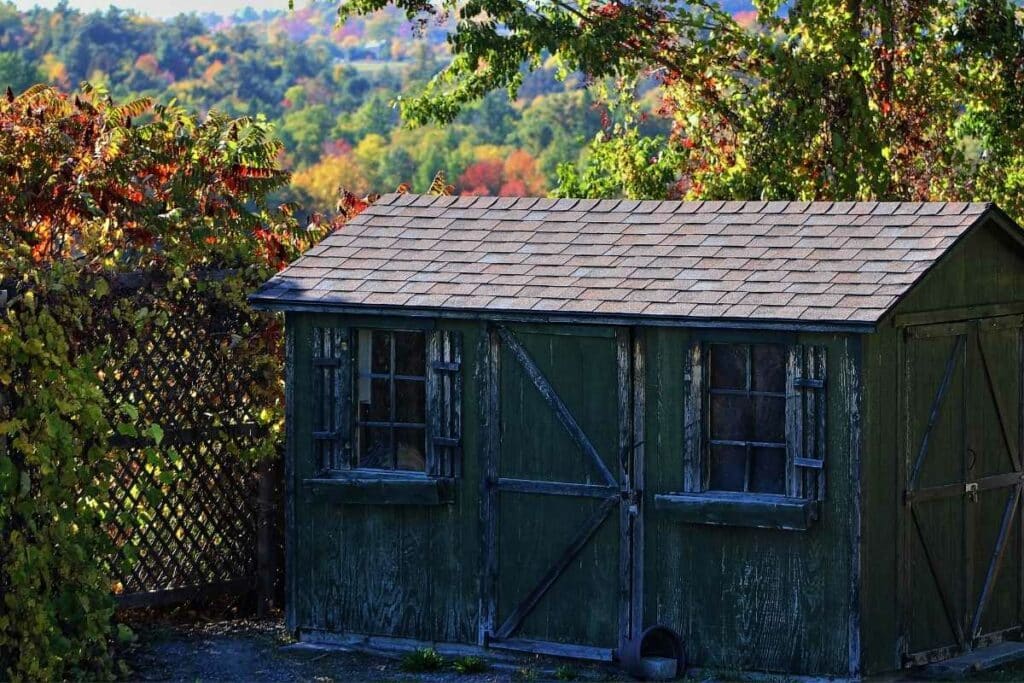
If you plan to spend time in the shed during the day, consider choosing a wall where a lot of sun will come in during the day.
You can set your worktable up on the other side of the window, and it will be a lot warmer when you are inside there working.