

In this expanded guide: Are Robotic Mowers Safe For Children and Pets · Do Robot Lawn Mowers Get Stolen? (Track and Trace Them) · Which Robotic Mower Trims the Closest to the Edge? · How Expensive Are Robotic Mowers to Run? · Do Robot Mowers Need Wi-Fi? · How Much Area Can a Robot Mower Cover? · Are Robotic Mowers Loud?.
If you’re on the market for a robotic mower, deciding on the right model for your property can be daunting.
With so many models, features, and prices it can be hard to identify an automatic lawnmower that will match your requirements and deliver time savings and convenience.
To assist you in selecting your ideal robotic mower, we share this insightful 11-point guide detailing things to consider before buying a robotic mower.
Familiarise yourself with the features and factors you need to be aware of and use this guide to evaluate the robotic mowers on the market.
11 Things to Consider Before Buying a Robotic Mower
Here are 11 things that every buyer should consider before buying a new or replacement robot mower.
11. Price
Price is going to be the primary consideration when splashing out on a new robot mower.
Purchasing a robotic mower for your garden is certainly an investment that delivers outstanding returns as time savings, rest, and relaxation on your carpet-soft lawn.
These automated lawnmowers are expensive starting at $500 to $600 dollars for the most compact, basic models and running as high as $5000 dollars or more for heavy-duty mowers that can mow expansive grounds and have advanced in-built technology.
Leading land management and garden tool dealerships like John Deere or Husqvarna often sell the more expensive robotic mowers and include additional services like professional installation or servicing.
See the latest prices for USA- Click Here
The key factors that affect the price point of the mower you buy include:
- The maximum area the robot lawnmower mows
- Features that increase the maneuverability and ability to handle varied terrain
- The capacity of the battery
- Advanced connectivity solutions including WiFi, Bluetooth and GPS
10. Garden Size
The mower you choose has to be a great match for your garden, and your lawn size will be a key determinant of the robot mower that you select.
This is because every robotic mower has a maximum area it can mow. The manufacturers usually provide this in square meters or feet so you can compare it with the dimensions of your lawn.
Here are some typical lawn area specifications for a robot mower:
- Small gardens: 600 square meters
- Medium-sized gardens: 1000 to 1500 square meters
- Large gardens: 2000 square meters plus
If you have an estate, large grounds, or are purchasing on behalf of a sports ground or professional landscaping company a professional robotic mower may be a better fit for your needs.
Here’s a handy run-through of how to measure the square footage of a lawn
9. Slope
Slope can make or break a mower and a robot mower that struggles on uneven terrain is going to be hard work for you rather than the mower.
Most robot mowers can cope with some gradient in the ground they are working but slope tolerated varies significantly between models.
Factors that affect slope tolerance include:
- The gradient and angle of the slope
- The presence of rain and moisture
- The wheel design and tread
- Center of gravity of the mower (the lower the better)
To know the gradient or percentage of slope to look for you will need to calculate the slope of your lawn. This requires some canes, a tape measure, string, and some 8th-grade maths.
8. Maneuverability
If you have a lot of obstacles on your lawn, you will need a robot lawnmower that can detect and dodge them rather than get stuck.
The quality of the lawnmower’s onboard technology will affect its ability to sense obstructions. Integrated sensors can detect obstacles that are in the mowing path of the robot and prompt it to change direction.
The number of wheels also affects the maneuverability of the mower with 4-wheeled or all-wheel drive mowers faring better with more complex lawn arrangements.
Aside from the hardware, the software algorithms used by the robotic mowers to calculate their mowing journeys will determine how they handle narrow passages, edges, and beneath objects like tables or trampolines.
7. Security/Safety
With an expensive and potentially dangerous garden tool like a robotic mower on your property, you’ll appreciate the reassurance of knowing that the model you opt for has robust and reliable security and safety features.
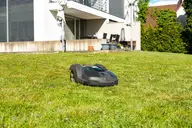
Though we leave robot mowers outside for a prolonged time, they are not tempting to thieves, because of their size, bulk and reliance on their complementary base station.
That does not mean that you should overlook security. These common security features will also protect the children and pets that use your garden too.
- PIN: you can secure even the most basic models of robot lawnmower with a 4-digit PIN
- Alarm: many automatic mowers have an alarm that is activated if they are picked up or someone enters an incorrect PIN
- GPS: onboard GPS means that you can track your robot mower, with alerts if it leaves its position
- Tilt and lift sensors: these sensors cause the mower to stop cutting if the unit is tilted or lifted off the grass
6. Manufacturer
Your choice of robot mower manufacturer will affect the price and specifications of your robotic mower.
There are many Chinese-manufactured OEM robotic mowers available at competitive prices, but some buyers prefer to purchase a mower from a reputable manufacturer via a dealership.
These manufacturers will also provide replacement parts, warranties, servicing and even professional setup of your new mower.
Leading manufacturers of robotic mowers include:
- WORX – the Landroid range of robotic lawnmowers
- John Deere – the John Deere Tango
- Flymo
- Husqvarna – the Automower range of robotic mowers
- Gardena
- Stihl – the iMOW range of mowers
- Bosch
5. Connectivity
Robotic lawnmowers are smart devices that can be integrated into the contemporary smart home ecosystem.
They combine a range of wireless networking technologies that allow them to be programmed and secured and navigate your lawn efficiently.
The Internet of Things capability of automatic mowers provides added convenience to owners who can remotely program and control their lawnmower.
These app-based controls are usually premium features and connect to the mower using:
- Wi-Fi: You can connect the robotic mower to an app-based control via a domestic Wi-Fi connection. You can also use Wi-Fi to link the mower to your property virtual assistant (Alexa) for voice command of your mower.
- Bluetooth: Bluetooth has a shorter range than Wi-Fi, so you will have to be within a 30-foot range of the mower to program it.
- GPS: GPS can also track the location and progress of a robotic mower in real-time.
Get an idea of how app-based control of a mower works with this explanatory video for the Bosch Indego mower
4. Control panel
All robotic mowers carry an onboard control panel you can use to program the mower and check its status and battery level.
A control panel should be as intuitive as possible with LCD displays being preferable in the abscess of app-based control.
Robotic mowers also carry an emergency stop button and a dial for adjusting the cutting height of the blades.
3. Blades
Robotic mowers have different blades, to cut and mulch your lawn, keeping it healthy and looking its best. The cutting action and quality are similar among manufacturers and models use one of three types of replaceable blade:
- Rotating razor blades: these blades are small and mounted on a rotating disc. They tend to wear out quicker than other types.
- Blades with star-shaped separations: these reversible blades have four or eight sharp edges and are mounted at a central point.
- Individually mounted fixed blades: these are strong durable blades that cut effectively.
Ideally, choose a mower with blades that can be obtained and replaced easily. The grass juices and debris can wear blades quickly and most mowers will need to have their blades changed once or twice per season.
If you want to learn more about how to change the blades of a robotic mower why not read our article: “How to clean and take care of a robotic mower”?
2. Warranty
As robotic mowers are so expensive a decent warranty is a must. Without a warranty, you will be stuck with the costs of repairing the mower if it fails early on.
The warranty guarantees a suitable level of performance from the robot mower, with manufacturers undertaking to repair or replace damaged or defective units.
Warranties for robotic mowers are typically between one and three years duration. Many require registration of the mower or purchase for an extension of the warranty period.
1. Supplies
A robotic lawnmower will be one of your hardest-working garden tools and it is almost inevitable that some part will wear or fail.
You need to be confident that you can source replacement parts easily and cost-effectively, especially consumables like blades and the boundary wire and connectors that can often become broken.
4 Great Robotic Mowers for the Smaller Garden
Here, we cherry-pick 4 great robotic mowers for smaller gardens to give you an idea of the type of mower that could work for you.
These are ideal for smaller backyards including urban gardens and condominiums.
1. GARDENA SILENO Minimo Robotic Lawnmower
- Maximum lawn area mowed: 2700 square feet (250 square meters)
- Cutting width/height: 6.29 in/ 0.78 – 1.77 in (16 cm/ 2 cm to 5 cm)
- Battery: Lithium-ion
- Working time: 65 minutes
- Dimensions: 20.4 in x 13.38 in x 8.66 in (52 cm x 34 cm x 22 cm)
- Weight: 13.44 pounds (6.1 kilograms)
- Warranty: 2-year warranty
Gardena is a German manufacturer of robot mowers that are designed for small and medium-sized gardens.
Features like its CorridorCut setting enable this robotic mower to mow tight passages and finish your edges.
It also boasts a spot-cutting setting that can mow evenly under objects on your lawns like tables or grills. It is weatherproof and will also sense frost to avoid damaging your lawn in the cooler months.
GARDENA SILENO Minimo – Fully automatic robotic lawnmower
The SILENO robotic mower is not only small but operates silently. It is also convenient to control via the Gardena smartphone app.
Once everything is set up, just use the app to enter your lawn size and your desired mowing schedule.
2. Bosch Indego S 500
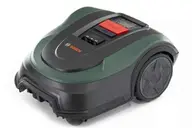
- Cutting height: 1.2 in to 2 in (3 cm to 5 cm)
- Maximum lawn area mowed: 5832 square feet (up to 500 square meters)
- Maximum gradient: 27 degrees
- Battery: Lithium-ion
- Working time: 60 minutes
- Dimensions: 44.5 x 36.4 x 20.2 cm
- Weight: 16.8 pounds (7.6 kilograms)
- Warranty: 1-year warranty
Bosch’s smart and compact mower handles up to 500 square meters of lawn area and is equipped with the features that smaller gardens require to look their best.
This little mower used LogiCut technology to mow your lawn in simple parallel lines, getting the job done in the fastest time.
It is specifically engineered to cut borders avoiding the straggly finish of some larger mowers. It also has onboard sensors that assist it in navigating even the smallest passages (75 cm wide).
If you have multiple small lawns, it can mow up to three of these within its maximum area of 500 square meters using its MultiArea function.
Once everything is set up this Bosch robot mower can auto-calculate and run a mowing schedule for you, using its calendar function.
3. Robomow RX20 Automatic Mower
- Cutting width/height: 7 in (17.8 cm) adjustable cutting height
- Maximum lawn area mowed: 180 square feet (16.7 square meters)
- Maximum gradient: 8.5 degrees
- Battery: Lithium-ion
- Dimensions: 26 in x 22 in x 12 in (66 cm x 56 cm x 30 cm)
- Weight: 27.9 pounds (13.5 kilograms)
- Warranty: 1-year warranty
Robomow is another robotic mower manufacturer that is cornering the market on automatic mowers for smaller gardens. This cheery beetle-like mower will keep the grass of a small garden in great condition with its efficient cutting and mulching action.
The manufacturers know that this mower will look tempting to kids and pets so they have fitted it with essential safety features like tilt and lift sensors that stop the blades, and PIN access to the control panel.
Robomow RX20 Battery Powered Mower
It can cut beyond the wheel, meaning you can retire your strimmer as it will handle your edges and other challenging areas.
You can control the Robomow RX 20 via Bluetooth and if you are looking for a robot mower with an even smaller footprint the Robomow R12u is currently the smallest robotic mower on the market!
4. Husqvarna Automower® 115H
- Cutting width/height: 8.7 in/ 2 in to 3.6 in (5 cm/ to 9.1 cm)
- Maximum lawn area mowed: 10882 square feet (1011 square meters)
- Maximum gradient: 30 degrees
- Battery: Lithium-ion
- Working time: 60 minutes
- Dimensions: 23.22 in x 17.71 in x 27.62 in
- Weight: 20.7 pounds (9.07 kilograms)
- Warranty: 1-year warranty
This is the most compact of the outstanding range of robotic mowers by Swedish garden tool experts Husqvarna and will competently mow lawns of up to a quarter ace in size.
Husqvarna is a great band to buy from because they deliver excellent support and replacement parts and servicing is easily accessible across the US.
You will be delighted with the quality of cut as Husqvarna specifically designed this 115H model for smaller lawns. It has high maneuverability and can dodge a variety of garden objects.
It is one of the best and most intuitive models for handling passages and can clear corners and tight areas of your lawn.
Husqvarna Automower® 115H Connect/4G Robotic Lawn Mower
Programming the 115H is ultra-convenient as you can connect to it via 4G/LTE, meaning that you can control your mower via a cellular connection from anywhere.
This is a great little robotic mower for consistent performance and durability.
Frequently Asked Questions for Robotic Mowers for Small Gardens
Is the installation for a robotic mower easy?
Robotic lawnmowers have a straightforward setup which usually includes installing the charging station, a boundary wire that surrounds the lawn area the robot will mow and configuring your mowing schedule and settings via the mowers onboard control panel or via an app.
Can my automatic mower create stripes on my lawn?
Interestingly, there are very few robotic mowers that can achieve this. This is because the mowing pattern of an automatic mower is essentially random, covering the entire lawn bit by bit.
Will a robotic mower damage trees and shrubs in my garden?
Many property owners initially worry that their robotic mower will lose control and head into their prized rose bush or other cultivated plants.
This is unlikely because the boundary wire that is installed around the perimeter of the lawn prevents the mower from mowing beyond it. Use boundary wire to surround trees and shrubs that are growing in your lawn.
Robotic mowers are energy efficient
They may initially be expensive but robotic mowers can be run cheaply. They are battery operated, with electric motors that are designed to be efficient.
Robotic mowers save you time
The time savings are a big attraction of these robots, that simply work around the clock to keep your grass at its best. You can use the regained time to enjoy your garden rather than maintain it.
You may still find yourself reaching for the strimmer
The design of robotic mowers creates difficulty in cutting the edge of your lawn. Though they are effective at mowing open areas, they may struggle with narrow spaces, corners, and dense foliage.
Are Robotic Mowers Safe For Children and Pets
Keep children, pets and wildlife away during mowing
Safety sensors reduce some risks but do not make a moving blade safe to approach. Follow the exact manual, keep children and pets outside the working area and stop the mower before anyone approaches it. Check the lawn for wildlife and obstacles before every run. Avoid dusk-to-dawn operation where hedgehogs or other nocturnal animals may be present; sensors may not detect them.
Sources checked 27 October 2026: Husqvarna: robotic-mower safety; BHPS: helping hedgehogs.
Are Robotic Mowers Safe?
It’s understandable to have concerns about having an autonomous mower working in your garden with pets and children around.
Even without the cutting action of a mower, you don’t want curious hands or paws prying, pulling, or damaging an expensive piece of equipment.
A Constellation of Sensors
Robotic mowers contain several types of sensors that feed the necessary information about their environment.
Typical Integrated sensors include:
- collision sensors
- tilt sensors
- contact sensors
- lift sensors
- ultrasonic sensors that detect obstacles
This information can then be used by the mower’s firmware to navigate.
These safety sensors have been designed to assist the robotic mower to complete its job effectively and efficiently, using the information it is fed regarding its surroundings.
High specification robotic mowers have onboard GPS that is used for navigation and tracking when they are in operation.
This satellite navigation system is reliant on the mower being exposed to the open sky as it works so that the GPS signal can become fixed on the device.
The big red stop button and glossy control panels of robotic mowers may be extremely tempting to curious children.
Do Robot Lawn Mowers Get Stolen? (Track and Trace Them)
Security features vary by model and connection
PIN access, alarms and location tracking can deter misuse but do not guarantee theft prevention or recovery. Check which functions are included, need a subscription or depend on cellular coverage and battery power. Keep serial numbers and proof of ownership; report theft to police and the manufacturer rather than attempting recovery yourself.
Over time, garden equipment has become increasingly high-specification, meaning that thieves look for opportunities to steal and resell valuable tools.
This makes the security of your robotic lawn mower a valid concern.
Is the Vandalism of Robot Mowers an Issue?
However, it’s possible that an unsavory character could deface your mower with graffiti, stand on it, or strike it with an object.
Common issues for these robots include:
- drinks cans lying around on the ground
- clothing laid on the grass
- blows to the mower from footballs or golf balls
Damage from Small Forgotten Objects on the Ground Is Mainly to the Blades, Which Can Usually Be Replaced
If the mower runs over something hard or tangling, the most vulnerable part is its rotating blades.
Alarms Will Let You Know If Your Mower Is Being Tampered With
An alarm is most effective if the owner of the mower can hear it as neighbors may ignore an alarm.
In some mowers activation of these sensors is linked to an alarm or automatic notifications via an app.
Apps Provide You with Remote Monitoring and Control of Your Automatic Lawnmower
As a ‘smart home’ device, you can remotely control robotic lawnmowers using an app and a wireless Wi-Fi or 4G/LTE connection.
From your smartphone, you can receive real-time updates on the status of the mower, progress with mowing and problems it has encountered.
You can also remotely program, activate, or shut off your mower using the app.
Which Robotic Mower Trims the Closest to the Edge?
Compare edge clearance against the actual boundary
A wall, raised kerb and flush paving edge allow different approaches. WORX’s discontinued WR153 example uses an offset cutting disc and advertises a remaining strip as little as about two inches; this is a manufacturer claim, not a measured comparison or a guarantee at your wall. Standard centred-disc designs can leave more manual trimming. Compare each current model’s installation offsets, side of cut and obstacle clearances, and never move a boundary closer than its manual permits.
Sources checked 27 October 2026: WORX WR153 Cut-to-Edge example.
Robotic Lawnmowers save You Time but Don't Always Get Everything Right
Though you’ll save a lot of time by having a robotic mower maintain your lawn through the growing season, you may still find yourself touching up edges and other areas that the mower has struggled with.
Grass growth at the edge of your lawn tends to be straggly and let down the appearance of the cut lawn.
Narrow passages and corners can have the same problem and have you reaching for the string trimmer or shears.
Why Can't Robotic Mowers Cut Edges Well?
Edges often remain with robotic mowers because of how these mowers are designed.
The positioning and operation of the cutting blades at the base of the mower.
The gap is most obvious when the mower runs along a wall, leaving a straight strip of uncut grass in its wake.
How Expensive Are Robotic Mowers to Run?
Calculate running costs with explicit inputs
Use measured or manufacturer-rated monthly electricity consumption and your actual tariff, then add model-specific batteries, blades, boundary repairs and service. Example only: 8 kWh per month × an assumed $0.20/kWh = $1.60 per month in electricity, or $9.60 over six months. This is arithmetic for comparing inputs, not current pricing or a claim about every mower. Include subscription fees where remote features require them.
What Are the Running Costs of a Robotic Mower?
The key costs for running your robotic mower will include:
- Electricity to power the power
- Replacement of parts such as the battery, cutting discs or blades, and broken boundary wire
- Servicing costs for your robot mower.
Electricity Costs for Your Robotic Lawnmower
Generally speaking, the electricity costs for running a robot mower are low.
Energy consumption will be affected by the technical specifications of the mower, including its mowing time, charging time, voltage and the power of its motor.
The battery is arguably the most important component of your robot mower – after all, your bot is going nowhere without it.
The lithium-ion batteries that most robotic mowers use are rechargeable and have good capacity.
However, each charging cycle leads to a gradual depletion of battery capacity as irreversible chemical reactions take place.
Cutting Blades Require More Frequent Replacement
This is understandable as they do the hard work of cutting and mulching your lawn continuously.
Outdoor conditions have a significant effect on the rate of wear on your mower blades, with gravel, pebbles, dog poop, fallen fruits and other objects potentially accelerating their blunting.
Boundary Wire Is Another Expense That Crops up from Time to Time
In a perfect world, it wouldn’t be necessary to include the boundary wire in the running costs of a robotic mower as it is meant to be a one-time install.
In the process of daily activity in your gardens the wire can take a hammering from:
- Digging
- Other garden tools
- The occasional nibbling of wildlife like rabbits or deer
And when it snaps in one place, you need to either replace the whole wire or splice it with a connector.
Servicing Your Robot Lawnmower Is Well Worth the Annual Cost
Routine servicing is a great investment in the longevity of your robotic mower and will help to keep it in great condition and cut grass well.
Most manufacturers will recommend that you service your robotic lawnmower every year, so that it can be properly cleaned, have any faults identified and remedied and have its software checked and updated.
Do Robot Mowers Need Wi-Fi?
Wi-Fi is one of several connectivity options
Check the exact model: Wi-Fi can connect an app through a home internet connection; Bluetooth is normally for nearby control; cellular connectivity depends on service coverage; some mowers retain onboard schedules without an internet link. Do not assume every remote command remains available offline. Husqvarna’s cited Wi-Fi guidance specifies 2.4 GHz for its supported Automower connection, not a rule for all brands.
Sources checked 27 October 2026: Husqvarna: Wi-Fi requirements.
How Does Wi-fi Connectivity Work on a Robotic Mower?
Robotic mowers that are Wi-Fi-enabled have an onboard Wi-Fi radio module and an internal antenna.
This enables the robotic mower to exchange data with Cloud-based applications designed by the manufacturer of the robot that can be used to remotely control the mower.
The robotic lawnmower needs to be connected to the domestic Wi-Fi router, access point or smartphone using a password for a secure connection.
Instant Remote Control of Your Robotic Lawnmower
Wi-Fi enabled mowers don’t have to be controlled via their onboard control panel.
You can use your smartphone for a wide range of commands for your robotic mower including:
- Switching the robotic mower on and off
- Controlling individual sensors
- Monitoring battery life
Conveniently Create a Schedule for Your Robotic Mower
Programming your mower via its control panel can mean endless, scrolling and button-pushing.
Smartphone apps provide an intuitive interface that makes it easy to create and change your robotic mowers schedule.
Receive Status Updates and Instant Alerts
Your robotic lawn mower can use its Wi-Fi connection to deliver updates on its progress and alert you to problems wherever you are in your home.
Wi-Fi Has the Potential Interference
The main frequency band used by Wi-Fi (2.4 GHz) is used by just about every other wireless device on the market, including Bluetooth-connected devices, cordless phones and even microwave ovens.
This means that domestic Wi-Fi can become congested with interference affecting your ability to control your robotic mower wirelessly.
Remember, You Have Other Wireless Connectivity Options for a Robotic Mower
There are many models of robotic mower that have app-based control via a smartphone app using wireless technologies other than Wi-Fi.
Here are the main alternatives:
Wi-fi Boosters Can Also Help You Increase Wi-fi Coverage in Your Home and Garden
If you are using the robotic mower to mow a large lawn or expansive grounds, it may be worthwhile extending your Wi-Fi signal using a Wi-Fi booster or Wi-Fi repeater.
This equipment includes external Wi-Fi antennas that can achieve greater coverage, keeping your robotic mower in range for remote control.
How Much Area Can a Robot Mower Cover?
Size capacity for the available mowing window
Compare rated lawn area, terrain, narrow passages, separate zones, recharge time and daily operating hours. A rating based on long daily operation may not suit a short daytime schedule that keeps pets and wildlife clear. Check manufacturer assumptions and allow for peak grass growth rather than treating area alone as a promise of completion time.
You can select a robotic lawnmower for a specific size of the lawn as manufacturers specify the maximum lawn area that can be mowed.
While you are evaluating robotic mowers for their working area capacity also check for these essential features
The size of your lawn is not the only factor to consider when evaluating a robotic mower to buy. Also, look out for these three features that can make all the difference to the performance of a robotic mower on your lawn:
Gradients
Slopes, inclines and hills can be a major challenge for some models of robotic mower, which will simply give up and stop cutting your lawn.
Mowing time
Getting the lawn mowed by a robot is a far more laid back affair than using a regular push-mower or ride-on.
Are Robotic Mowers Loud?
Compare like-for-like noise measurements
A sound-power rating is not interchangeable with sound pressure measured at a particular distance. Compare the same metric and test conditions, then follow local noise rules and choose considerate daytime hours. No mower is guaranteed silent, and new rattling or unusual vibration needs investigation with the power isolated.
Noise levels vary between models of robotic mower
Some robot mowers are louder than others.
This is because they vary in specifications, engineering and the power of their motor.
You can check the noise level of the robotic mower, measured in decibels
If quiet operation is important to you, most manufacturers will include the operating volume of their robotic mowers, measured in decibels, as part of their technical specifications.
As your robot mower ages, you may notice an increase in volume
Loud noise like rattles and bangs indicate a problem.
If you hear these noises, switch off your lawnmower and take it in for professional servicing.
Rounding Up
We hope that this 11-point buying guide has provided you with food for thought as you select your ideal robotic mower.
As we have said above, it is a big investment, but if you get it right these mowers will deliver great performance and value for money.
If you would like to look at some of the robotic mowers on the market right now our article “Best Robotic Lawn Mowers USA” is a round-up of seven of the best models for US gardens.
If you’re in the UK – Check out this page full of helpful information for UK models