

If you have trees on your lawn you may be wondering if a robotic mower can cut around trees. Trees of any size increase the complexity of a lawn and are potentially a significant obstacle for both conventional and robotic lawnmowers.
Experienced gardeners are well aware that garden equipment can do serious, if not fatal damage to trees.
The risk of harm from a mower is especially great when a tree is young so it’s understandable if you are concerned about the potential for damage from a robotic lawnmower.
In this article, we will explain how robotic mowers cut around trees keeping them safe from damage, and a few things you can do to make sure that both your tree and your robot mower are extra safe.
Thankfully robotic mowers can handle navigating around common garden objects like trees
Robotic mowers have been designed with consideration of the common objects and hazards the machine will encounter in the average backyard.
Trees are going to be a priority and manufacturers have developed technology that effectively senses and responds to trees and other obstacles so that the robotic mower can effectively navigate around them.
If a robotic mower approaches a tree, its array of onboard sensors will detect the physical obstruction prompting the robot to stop mowing, reverse and change direction.
This process is continued repeatedly from every direction in which the tree comes into range. Eventually, the lawn is fully cut without any contact or damage to nearby trees.
Ultrasonic sensors are critical safety and navigation technology for robotic mowers
Robotic lawnmowers use ultrasonic sensor technology to navigate their environment without human intervention. The boundary wire that is used to demarcate the lawn cannot assist the robot with sensing obstructions in its path while on the lawn.
Read if all robotic mowers need a boundary wire?
The autonomous mower uses ultrasonic sensing can detect the terrain it is on along with objects that are in its path.
An array of sensors emit high-frequency sound waves (beyond human hearing) that bounce off different objects and are reflec to a transducer on the mower.
Processors in the robotic mower complete complex distance and acoustic measurements that help the mower detect the presence of an object by the differences in echo response.
Correct insulation and mounting of sensors on a robot mower will detect trees
The transducers used on robotic mowers can cope with sensing objects in all weather conditions.
They are usually closed top transducers that are surrounded by a soft material that allows the sensor to vibrate and a firm housing that keeps it held in position on the front of the lawnmower, facing outwards just above the ground.
Without secure mounting, the mower may detect objects that are not theirs.
Depending on the sensitivity of the transducer, it detects objects within a 15 cm range of the robotic mower as hazards and prompts the mower’s electronic systems to instruct the mower to change direction.
The mower then searches for an unobstructed path to continue mowing.
Sensor technology makes robotic mowers safer for trees and Children
The sophistication of robotic lawnmowers makes them the safest choice for mowing lawns where trees are present. The damage done by other grass-cutting appliances can prove fatal to trees.
Mowers are notorious for inflicting a variety of tree injuries that threaten the health of a tree and structural integrity.
The blades on a lawnmower can damage the bark of the tree wounding it and introducing disease.

One of the most vulnerable areas of a tree is where the tree comes out of the turf, known as the root flare area. Mowers of all kinds can strike this area, theoretically including robotic mowers.
Damage to this area can compromise the cambium of the tree, a specialized vascular network that transports nutrients throughout the tree.
Lacerations or removal of protective bark by a mower or weed eater will disrupt this transportation system, causing long-term damage through the introduction of pests, fungi, and diseases that further weaken the tree.
A dead tree on your lawn cannot be left as it may collapse on anyone who uses your lawn.
Read our review of the Best Robotic mowers available in the USA here.
Can a robot mower cut through bark?
A robotic mower is certainly powerful enough to cut through the bark of the tree, but the sensor technology described should keep it away from a tree.
The edge cutting function of some mowers exposes more of the blade which could potentially damage a tree in the grass or exposed roots could be damaged by the mower running over them.
Strategies for protecting your trees
If you are still concerned about the potential for damage to your tree, you may want to consider the ways in which you can protect your trees.
Here are some methods you can try:
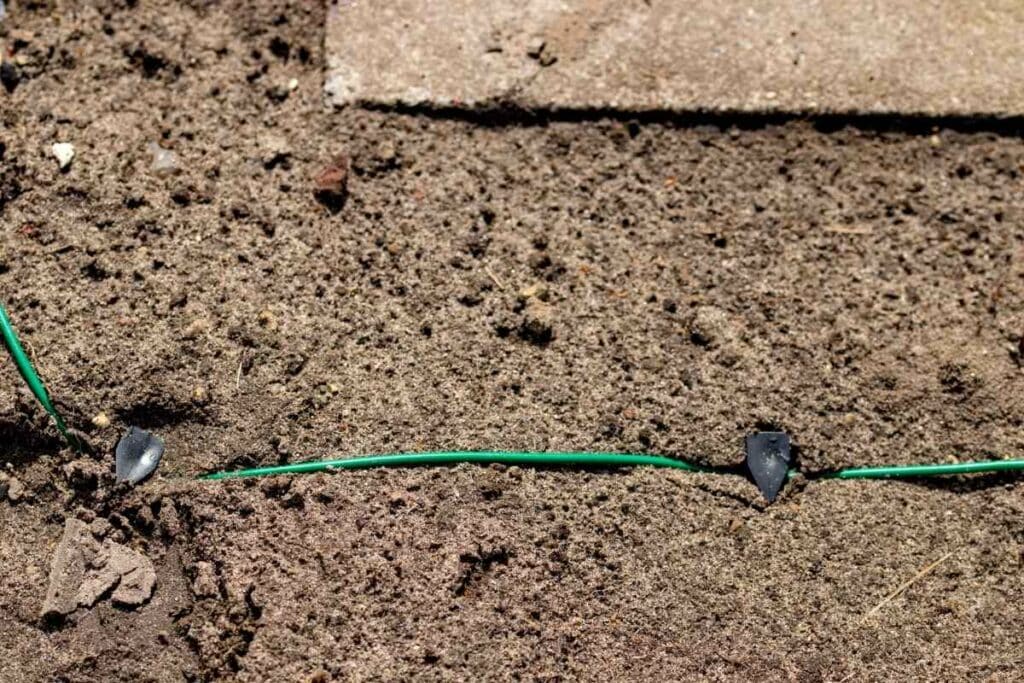
Create a boundary around your tree with the robotic mowers perimeter wire
Cordoning off your tree with perimeter wire makes it certain that the robotic mower will not approach or harm your tree.
This is because the wire sends out a signal that demarcates the edge of your lawn, causing the mower to automatically change direction.
Any grass close to the tree that is on the other side of the boundary can be trimmed manually.
Build a protective structure around your tree
A young tree is not only at risk of damage from a mower, but also wildlife, pets, and backyard rough and tumble!
For complete peace of mind, you may want to build one of the following structures around your sapling:
- Two short posts with flexible mesh
- A plastic tube and post
- Chicken wire or weld mesh wrapped around the trunk and staked
- Three to four posts with timber top bars
- Iron welded railings
Consider planting flowers in a raised bed
An alternative physical barrier for prized plants is a raised bed that provides an instant blockage for a wandering robotic mower.
Raised beds not only protect your flowers from being accidentally mown but also prevent weeds, have better drainage, and are warmer for a longer growing season. It is also less likely a ball or enthusiastic pet will land in the middle of your flowers too.
You can experiment with a variety of designs using wooden or plastic sides for a store-bought or DIY raised bed.
In a large garden with multiple flower beds in the lawn, divide the grass up into zones
If you have expansive grounds with multiple flower beds, you may need to divide up the lawn into specific zones for your mower to work on individually to minimize the risk of flowers being chopped up.
Some models of robot mowers allow you to create different zones for mowing in your garden. You can assign grassed areas as the main area, adjoining areas, and separate areas with their own start points and mowing schedule.
Can Robot Mowers Go Over Paths?
Plan paths and separate zones to the manual
Check permitted crossing width, slope, step height and wire or virtual-boundary clearances for the exact mower. Exclude loose gravel and hazards; never assume a mower can cross a public path or road safely. If zones cannot be connected safely, use the manufacturer’s secondary-area procedure and move the stopped mower as instructed.
Ideally: You would like your mower to head straight over the path and start mowing the grass on the opposite side, but depending on the type of path, its width, levelness, and overall condition, things may not be so easy.
Uneven Surfaces Present a Challenge for a Robot Mower
Things get dicey when your robotic mower has to take on surfaces that are uneven or made up of little bits of material.
After All – The mower is carrying high-speed pivoting razor blades that items like bark, slate, or pebbles can ricochet off.
The effect of these types of path materials can be unpredictable and may cause the following problems for your robotic lawnmower:
- Ricocheting projectiles: The high-speed blades may contact loose gravel or pebbles that can be flung as speed from the mower causing damage or injury to anything nearby.
- Items becoming caught up in the mowers cutting mechanism: Small stones and debris may even become wedged between the blades or enter the running mower causing damage or outright failure.
- The robotic mower can become frankly stuck: Some of these loose path materials may simply be unnavigable for your robot, holding up the mowing of your lawns.
These problems will be worse when the cutting height is very low.
Height Differences in Paths Are a Headache for Robot Mowers
Lawn paths are easiest to cross when they are flush with the lawn edge.
If you are laying a lawn path, make sure that your stones are level or create a navigable slope onto and off the stones.
Artful Use of Boundary Wire Can Help Your Robot Mower Avoid the Path
Stop your mower from grating itself of nasty gravel paths by leaving them out using your boundary wire.
This will prevent the mower from trying to cross or even mow them.
Turn Your Lawn in to Multiple Separate Mowing Zones
An awkwardly located driveway or unavoidable path that divides your grass can be vetoed permanently by cheating two separate mowing zones for your robot to mow.
It can then be programmed with main and secondary mowing zones that have their own starting point.
You may have to move your mower between the zones.
Create Passages for Your Robotic Mower to Navigate
Create paths and bridges for mowers to get to different areas of your lawn by laying some flat, easily traversable paving stones or creating a passage with boundary wire.
Rounding up
As you can see, robot mowers are a safe option for trees as they can simply cut around them.
If you have trees in your garden, they could be more risk to your robotic mower than the other way around as leaves, pine cones, fallen fruit, and branches can all potentially damage the blades and underside of a robotic mower.
But with proper preparation and monitoring, your tees and robot mower can share your garden happily.