

The quality of your compost largely determines your garden’s health.
Before placing compost in your garden, it’s important to test the quality to ensure you are only providing your garden the nutrients it deserves.
You can easily test your compost quality by analyzing its color, odor, structure, and temperature. You can also try the wood break test or buy a professional testing kit. Each one of these six analysis methods is easy to reliably analyze the quality of your compost.
To learn more about how to test your compost quality with the above-mentioned six methods, read on.
What Is Quality Compost?
Quality compost is roughly 35% to 65% organic content based on the dry weight.
Whenever the compost has this content, it is best able to nurture your garden and its plants.
If the compost is too dry, most of the nutrients will already have been wasted, meaning that the compost won’t do much good for your garden.
Conversely, compost that is not mature yet runs a high risk of damaging and burning your delicate plants.
Needless To Say: It’s important to only put quality compost in your garden. Only then will the compost be able to nourish your garden and its plants the way you want it to.
6 Easy Ways to Test Compost Quality
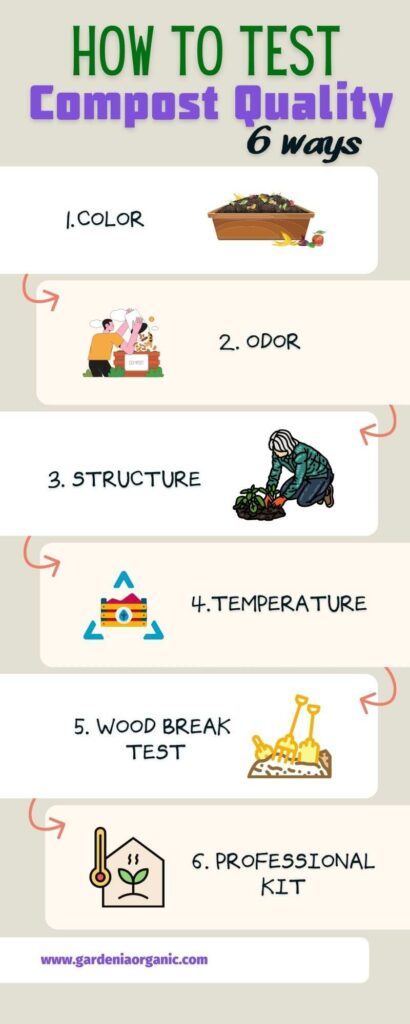
Testing the quality of your compost pile is actually relatively easy.
Using two of your most basic senses – sight and smell – you can eyeball this stage of compost maturation.
For a more definitive answer, you can test its temperature or perform an easy wood break test.
If you are using the compost for commercial purposes, you should buy a professional kit as well.
Although the professional kit will cost money, it is the only way to get a definitive answer about the quality of your compost.
Personal compost will not need the professional kit.
1. Color
Whenever you first start your compost pile, it will be filled with numerous colors and chunks of items.
If you can still see a lot of different colors, especially big pieces of the color, your compost is not ready yet.
Instead, the color should homogenize during the decomposition process.
What this means is that your compost should become an even dark or rich brown color. It may even be so dark that it appears black.
If you see gray bits in the compost, it likely means that the compost has dried out too much.
So, shoot for a color that is in between dark brown and black.
What To Expect: Although it’s okay to see little specks of different colors, it should look like a single color from a distance.
2. Odor
Practically everyone knows that compost piles can have a gnarly odor.
As the pile matures, the odor should change and become more agreeable to your nose. If your compost pile is still an offense to smell, it likely is not ready yet.
The reason for this is that young compost piles release a lot of ammonia. It is this chemical that causes a terrible smell. As the compost matures, this smell should subside.
Eventually, it should be practically indistinguishable. This is why mature compost often smells like regular soil.
If your compost simply smells like dirt, it likely is mature and ready to go in your garden.
3. Structure
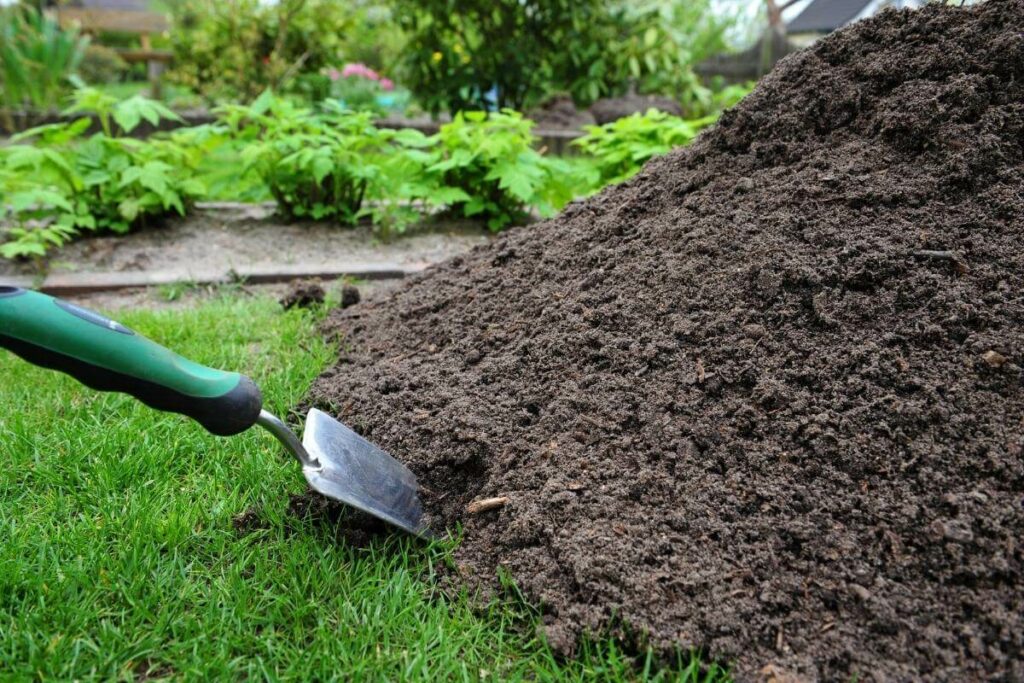
You can further test the maturity of your compost by analyzing its structure.
The best compost has no recognizable material, with the exception of small bits of wood, much like mulch.
More so, the compost should have a crumbly texture and include some fibrous material.
That being said, the compost should not have too much fibrous material. If you can see too much of this material, it means that the compost is not mature.
Often, this material builds up because of excessive humidity.
So, look for compost that has a crumbly-like texture. Many compare mature compost to course sand in terms of the structure and feel.
4. Temperature
As you likely know, compost breaks down thanks to microorganisms in the pile.
As the different materials are being broken down, they generate heat.
Compost piles that are breaking down will be much hotter than mature piles. At the same time, the piles shouldn’t be too hot or too cold.
Healthy compost piles will typically be between 90 degrees Fahrenheit and 140 degrees Fahrenheit.
You can only expect the pile to adequately reach these temperatures if it is 3 by 3 by 3 feet or so.
Note that various parts of the pile will be at different temperatures.
The reason for this is that the temperature fluctuates from the center outwards.
5. Wood Break Test
All of the above methods are ways that you can quickly predict whether or not your compost pile is mature, but they don’t guarantee that to be the case.
A more reliable way to test the quality of your compost is with the wood break test.
This test involves putting a piece of wood into the pile to see how it degrades:
- In young compost, there will be minimal degradation signs.
- As the compost begins to mature, the wood will become slightly tender, dark, and greasy, but it won’t fully break down yet.
You know that the compost is mature once the wood becomes tender and the surface is dark and black.
You will be able to easily press water out of the wood at this point too.
Once you see this happening to the wood, you know that your compost is high quality.
6. Professional Kit
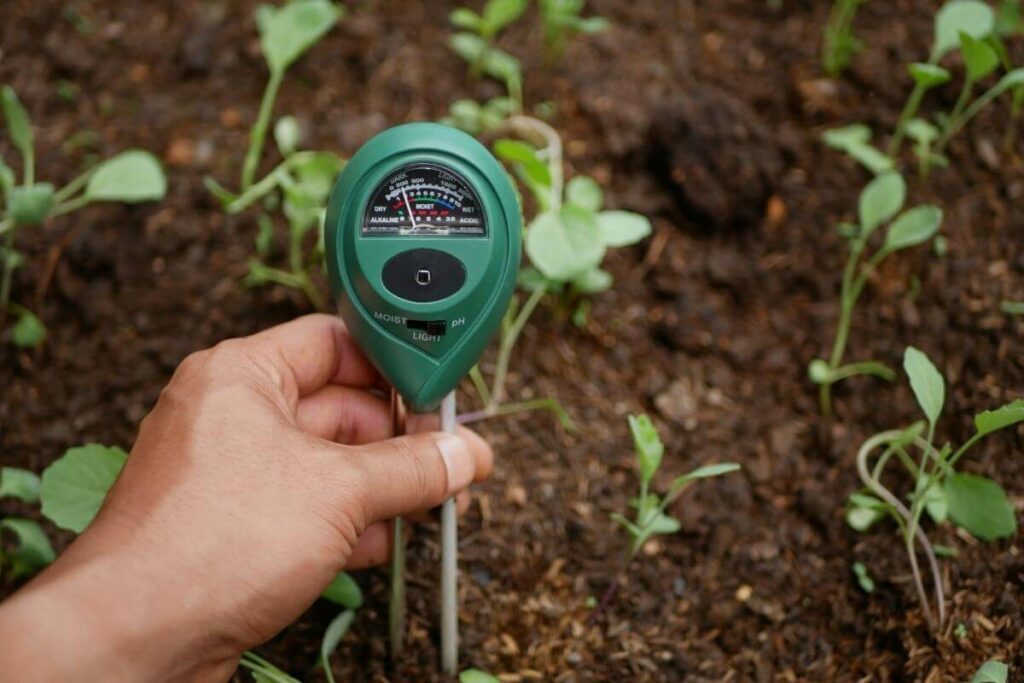
The most definitive way to ensure that your compost is mature is to hire a professional to perform a compost test.
You might be able to buy a kit from a local farm or garden, but you can also contact a professional biochemical company to do the test for you.
During this test, the compost will be tested to assess its biochemical makeup. More specifically, the organic matter will be analyzed and the ratio of the micronutrients will be listed.
This will tell you exactly what is inside the compost and if it is ready to be used yet. Some tests even test for possible pollution.
Although this is the most definitive way to confirm the maturity of your compost, it can be the most inconvenient and expensive.
Good To Have: If you are simply wanting to use compost for personal use, the above wood breaking method should work, but you should buy a professional kit if you are using the compost for commercial purposes.
A Smell That Makes Your Eyes Water
Fresh, healthy compost should only ever smell like clean earth, but a strong smell that reminds you of a blocked drain means something’s not right in the pile.
Again, it’s fixable.
It will probably mean your pile has become anaerobic, which means that it’s not getting enough oxygen. It can also mean there’s too much moisture in the pile, so it’s a soggy, stinking blob.
Turn the compost regularly, making sure oxygen’s getting to the whole pile. Top it up with drier, carbon-rich materials like dead leaves and cardboard and avoid adding any more nitrogen.
Over time, you’ll see that with enough turning and the right balance of materials, normal order will be restored.
The Pile’s Soaking Wet
The same issue as above will occur if the pile is exposed to too much water.
In this case, the primary job is to get rid of as much moisture as possible before doing anything else.
Spread the pile out, allow the contents to dry, and start again.
Don’t Forget: If you live in an area that gets a lot of rain, try putting your pile in a sheltered place with a roof, such as an outhouse. Failing that, invest in a compost bin to protect it from the elements.
Why Does Unfinished Compost Affect Nitrogen Levels?
Unfinished compost has an impact upon the nitrogen levels in your existing soil when you add it because the compost will “borrow” nitrogen from the surrounding soil as it decomposes.
This pulls it into the compost, and makes the nitrogen unavailable to the plants in that area. The more carbon in your unfinished compost, the more nitrogen it will pull from the surrounding soil to compensate.
In general, the bits of compost that are left at the end of the process are high in carbon (as a lot of nitrogen-rich ingredients like grass and food waste break down quickly).
While the nitrogen levels will eventually rebalance when the compost has finished decomposing, this can be harmful to plants that need nitrogen readily available, and can lead to nutrient deficiencies.
What To Avoid: It’s not a good idea to add unfinished compost around the base of any plants that need plenty of nitrogen, or you may find you have to fertilize them with nitrogen to maintain healthy growth.
Using It as Mulch
You can use unfinished compost as a mulch around your plants, creating a thick bed to trap moisture in the soil during the summer. This is great around large plants such as bushes and trees in particular.
It’s not a good idea to mix unfinished compost with your normal soil in areas where you intend to grow plants very soon, or where existing plants are growing.
You can do so if you include an extra source of nitrogen or the plants are particularly hardy, but otherwise, only use it as a mulch on top of the soil.
This will stop it from having a noticeable impact on the soil beneath, because it will only be in contact with the surface, and won’t pull nitrogen from around the roots of the plants.
Over time, the goodness in the compost will start to wash into the soil, and the unfinished compost will continue to decompose and turn into finished compost.
This should result in richer soil overall, without the negative impact on the plants.
It’s Up To You: When the compost has totally finished, you can dig the mulch into the soil, but you don’t have to. The nutrients will wash down and become available to the roots over time even if the compost remains on the surface.
Perfect Conditions for Worms
Next, if your bin gets too compacted, the worms will leave.
That means that every now and then, you should stick a garden fork in and lift and stir the compost around.
Shifting the heap helps to break it up, ensure everything is composting, and add air to compost that might otherwise have little oxygen in it.
You can also keep your bin loose and aerated by adding lots of structured materials.
Sticks and tough stems might take a long time to break down, but they are an invaluable source of air pockets in your compost.
Worms will benefit from this, and will also help with it, because they aerate the heap as they crawl around inside.
As long as your compost is looking healthy and breaking down nicely, you should find that worms live in it.
They may retreat deep into the ground when the weather gets cold, but they will soon return.
Make sure your compost bin stands on bare earth, or you may not be able to attract worms.
What to Avoid: If your bin stands on concrete or another hard surface, try and find somewhere else to put it. It will still work on concrete, but not as efficiently and your compost may be lumpier.
Should I Buy Worms?
Some people do buy worms for their compost heaps, so you can do this if you want to.
However, if your bin stands on earth, the worms will usually find their own way into the compost heap, and you can save yourself some money, plus postage waste.
You can also find worms yourself if you want to, but be aware that compost worms are not earthworms, so just digging a handful of these up will not do.
There are a few different kinds of compost worms, but the commonest kind is called red wiggler. These are thin, red colored worms.
They have many other names, and there are a few different species that often get confused, as they are quite similar to each other.
In general, as long as they are composting worms, they will do the job.
You can’t just dig them up in your yard or local park, however. If you have a friend who composts, you may be able to get some worms from them.
The worms multiple rapidly and will soon fill their food space, so you don’t need to worry about depleting your friend’s compost.
A few handfuls will be plenty, and they will soon have your compost bin alive and wriggling.
From Experience: Ordinary earthworms will not work for your compost bin, and there is no point in adding them. They feed at much lower depths, and therefore they will not wriggle through your pile, making you nice, crumbly compost.
Final Thoughts
Before throwing any compost on your garden, it’s imperative that you test its quality and maturation.
If you put compost in your garden too quickly, it will likely damage and kill all of the plants.
However, the compost won’t help much if you wait too long.
The easiest way to test the compost quality is to consider the color, odor, and structure. Once your senses show the compost is mature, take the temperature or perform the wood breaking test to confirm the assumption.
Commercial growers should go a step further to confirm the quality of their compost by hiring a professional kit.
We hope that this article has helped you learn how to determine the quality of your compost so that you can perfect your garden.
Related Articles
- Can I Use Compost For Overseeding?
- Topsoil Vs. Compost: Which One Is Better?
- What Is Black Bag Composting?